Why favourites lose in football is easier to explain than it feels on the day: even a team given a 70% chance of winning fails to win three matches in every ten. What looks like a shock at full time is, over the long run, exactly what the odds said would happen.
The useful skill is telling an upset the numbers allowed from a favourite that was genuinely overrated. Below are five reasons football upsets happen, why they always look obvious afterwards, and what all of it means if you use predictions to make decisions.
A favourite is a probability, not a promise
Ask why favourites lose in football and the first answer is arithmetic. When a model or a bookmaker calls a team a 70% favourite, that is a statement about a large group of similar matches, not about this one. Picture ten identical fixtures. The favourite should win about seven. The other three are not mistakes in the forecast; they are the other 30%.
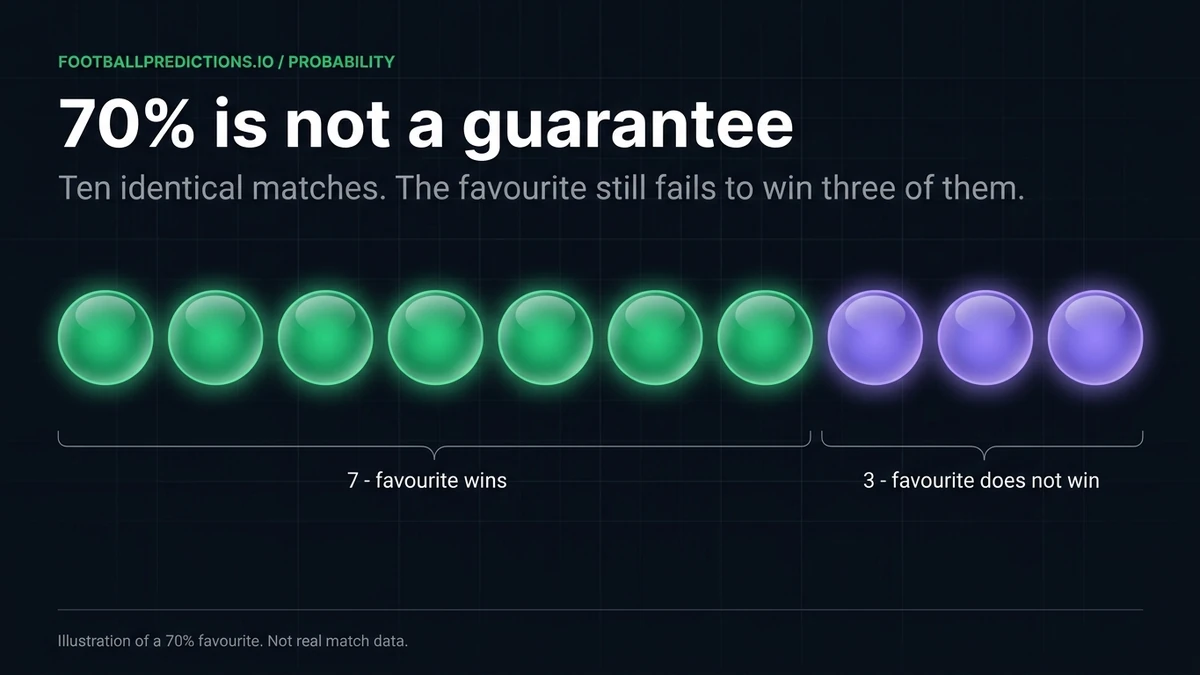
Seven wins, three upsets: this is what a 70% favourite looks like in practice.
Most favourites are not even that strong. In a typical league round a favourite is usually rated somewhere around 50–60%, which means that not winning is a very normal outcome, not a rare one. The table shows what different ratings mean over ten matches.
| Favourite’s win chance | Fair odds | Fails to win (per 10 matches) |
|---|---|---|
| 50% | 2.00 | 5 |
| 60% | 1.67 | 4 |
| 70% | 1.43 | 3 |
| 80% | 1.25 | 2 |
| 90% | 1.11 | 1 |
Why favourites lose in football: five reasons
None of these reasons needs a conspiracy or a collapse. They are built into the sport.
1. Football is a low-scoring sport
A typical top-flight match produces around two and a half to three goals in total. With so few scoring events, one deflection, one penalty decision or one goalkeeping error can swing the whole result. In higher-scoring sports luck averages out over dozens of scores; in football it has only a handful to average over, so the better team wins less reliably.
2. The draw takes a big slice
Roughly a quarter of matches in the major European leagues end level. A favourite that dominates but cannot finish still collects a point, and a bet on that team to win is lost. Many matches described as “the favourite lost” are in fact draws, and the draw is frequently the most common way a favourite fails to win.
3. One moment can outweigh ninety minutes
A red card in the 20th minute, an early goal against the run of play, an injury to the goalkeeper. Expected goals (xG) shows how often a team creates better chances than its opponent and still loses. Over a full season results follow xG closely, but in a single match they can point the other way. If you want the background, our guide to expected goals explains how the numbers work.
4. Reputation is priced in
Big clubs attract big public money. When many people back the famous name, the price can become shorter than the team’s real chance, which turns a favourite into a brand rather than a measured probability. A well-organised, lower-profile side can then be better value than its reputation suggests.
5. Context the table does not show
Rotation before a midweek European tie, a key defender missing, little left to play for, a new manager, a long trip. Any of these can turn a favourite on paper into a weaker team on the pitch. Home advantage matters too, although it is smaller than it used to be: see our look at home advantage in football.
Why upsets look obvious afterwards
Hindsight also distorts how we remember why favourites lose in football. Once the result is known, memory quietly rewrites the story. The loser’s weaknesses seem to have been visible all along, and the winner’s victory seems to have been inevitable. This is hindsight bias, and it is one of the best documented habits of human judgement.
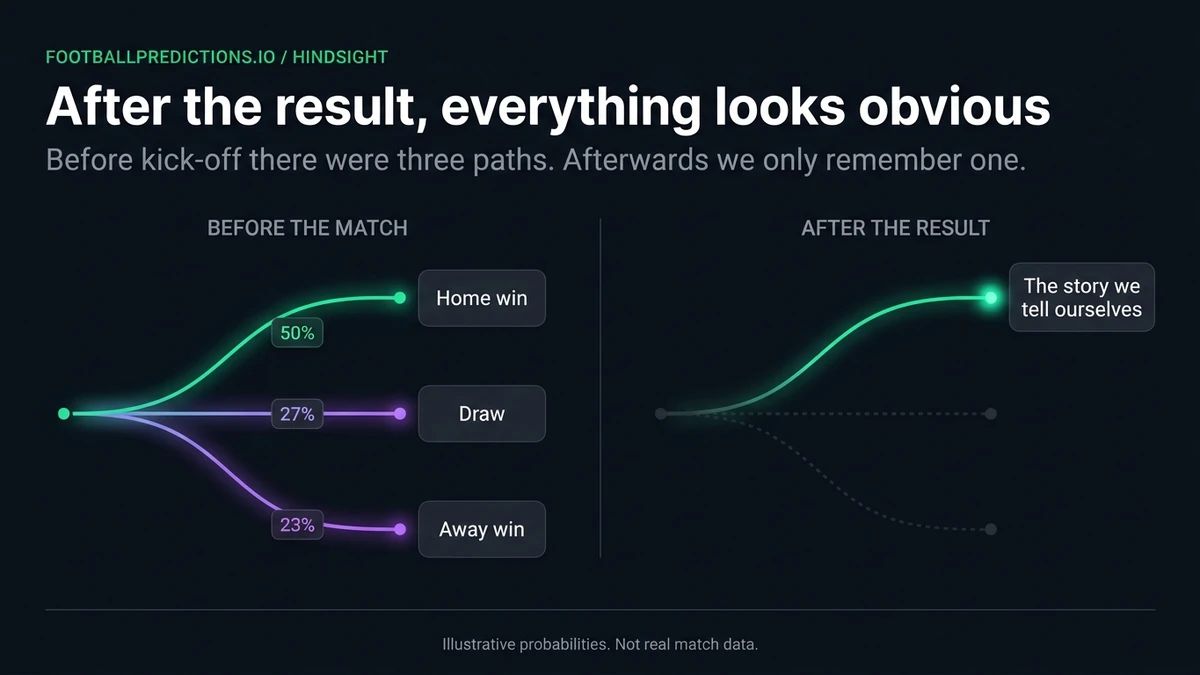
Before kick-off there were three paths. Afterwards we only remember the one that happened.
The fix is simple but uncomfortable: judge a forecast by the probability that was available before kick-off, not by the feeling you have after the final whistle. A 30% outcome happening is not evidence that the 70% was wrong.
It is also why a single result tells you very little about a model. If you want to see how predictions are built and tested, start with how AI football predictions work.
What this means for your bets
Understanding why favourites lose in football changes how you should use a prediction. Four habits are worth building:
- Judge the price, not the result. A true 70% chance has a fair price of about 1.43. Odds above that are value, even though the pick will still lose three times in ten.
- Respect the draw. Markets that cover it, such as Double Chance, exist precisely because so many favourites fail to win without actually losing.
- Look at a hundred bets, not ten. A short run of upsets is normal variance and says little about the quality of a forecast.
- Check the context before you trust the label. Line-ups, rotation and motivation can matter more than the league table.
You can see this approach in practice in our analysed tips, where each pick is published with its market before kick-off.
Frequently asked questions
How often do favourites win in football?
It depends on how strong the favourite is. A team rated at 70% should win about seven matches in ten, while a narrow 55% favourite wins only slightly more than half. Because many favourites sit around 50–60%, dropping points in close to half of their matches is normal, and it is the simplest answer to why favourites lose in football so often.
Are upsets more common in football than in other sports?
Generally, yes. Low scoring means a single event can decide a match, and the draw adds a third outcome that most major sports do not have. Together they make football one of the harder major sports to predict match by match.
Does a favourite losing mean the prediction was wrong?
Not necessarily. A probability is judged over many matches. If 70% favourites win about 70% of the time across a large sample, the forecasts are well calibrated, even though every single defeat feels like a miss.
Should you avoid betting on favourites?
No. The real question is whether the odds are higher than the team’s true chance justifies. A favourite can be good value or poor value; the label alone tells you neither.
That is why favourites lose in football, and why it should not surprise anyone. Upsets are not a flaw in the game or in good forecasting. They are the share that every honest probability leaves room for.
18+. Betting involves risk and you should never stake more than you can afford to lose. If gambling stops being fun, support is available at BeGambleAware.org.