Use this free odds calculator to convert decimal, fractional and American odds, see the implied probability behind any price, work out your return and check how much margin the bookmaker builds into a market.
Uses the odds and stake from step 1. Value exists when your estimated chance is higher than the implied probability.
How to use the odds calculator
The odds calculator above works in three steps. Each step updates instantly as you type, so there is no button to press.
- Choose the odds format you have: decimal (1.75), fractional (3/4) or American (-133).
- Type the odds and your stake. The calculator converts the price into the other two formats and shows the implied probability, your total return and your profit.
- For a value check, add your own estimate of the chance in percent. The odds calculator compares it with the price and shows the expected value of the bet.
- To see how much the bookmaker keeps, enter the home, draw and away prices of a 1X2 market in the third section.
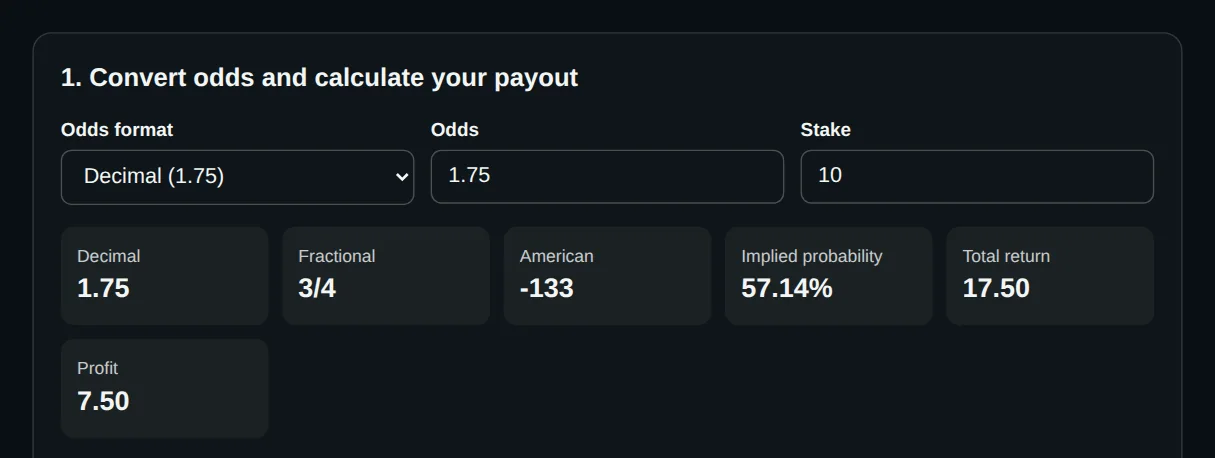
Example: odds of 1.75 shown as 3/4 and -133, with a 57.14% implied probability.
What implied probability tells you
Every price hides a probability. The formula is simple: implied probability = 1 ÷ decimal odds. Odds of 1.75 imply 1 ÷ 1.75 = 57.1%, odds of 2.00 imply 50% and odds of 4.00 imply 25%.
This number is the most useful thing an implied probability calculator can give you. It turns a price into a statement you can test: “the bookmaker thinks this team wins about 57 times in 100”. If you believe the real chance is higher, the price may be worth taking. If you believe it is lower, it is not, however attractive the payout looks.
Decimal, fractional and American odds explained
The three formats describe exactly the same thing. Decimal odds show the total return for a stake of 1, including the stake. Fractional odds show the profit relative to the stake, so 3/4 means you win 3 for every 4 you bet. American odds use 100 as a base: a plus sign shows the profit on a 100 stake, and a minus sign shows how much you must stake to win 100.
| Decimal | Fractional | American | Implied probability |
|---|---|---|---|
| 1.50 | 1/2 | -200 | 66.7% |
| 1.75 | 3/4 | -133 | 57.1% |
| 2.00 | 1/1 | +100 | 50.0% |
| 2.50 | 3/2 | +150 | 40.0% |
| 3.00 | 2/1 | +200 | 33.3% |
| 4.50 | 7/2 | +350 | 22.2% |
The odds calculator above also works as an odds converter: type a price in one format and read the other two straight away. Our guide to football betting odds explains each format in more detail, with worked examples.
Bookmaker margin: why the percentages add up to more than 100%
In a fair market the implied probabilities of all outcomes would add up to exactly 100%. In practice they add up to more. Take a match priced at 2.10 home, 3.40 draw and 3.60 away. The implied probabilities are 47.6%, 29.4% and 27.8%, which add up to 104.8%. The extra 4.8% is the bookmaker margin, also called the overround or vig.
The third section of the odds calculator works this out for any 1X2 market and also shows the fair odds once the margin is removed. Comparing margins between bookmakers is one of the easiest ways to get better prices over a season.
Using the odds calculator to spot value
A value bet is a price that pays more than the real chance deserves. The test is expected value: EV = your probability × decimal odds − 1. If you rate a team at 60% and the odds are 1.85, the EV is 0.60 × 1.85 − 1 = +0.11, or +11% of your stake in the long run.
A positive number does not mean the bet will win. It means that, over many similar bets, the price pays more than the risk. That is the idea behind value betting in football, and it is also why even strong favourites lose regularly, as we show in why favourites lose in football.
Frequently asked questions
How do I calculate implied probability from odds?
Divide 1 by the decimal odds and multiply by 100. For fractional odds, first convert them to decimal by dividing the two numbers and adding 1, so 5/2 becomes 3.50 and implies 28.6%. The odds calculator does both steps for you.
Which odds format is best?
None is more accurate than another. Decimal odds are the easiest for quick maths, which is why most of Europe uses them. Fractional odds are traditional in the UK and Ireland, and American odds are standard in the United States.
Does the calculator work for any sport?
Yes. The maths is the same for football, tennis, basketball or any other sport. Only the bookmaker margin section assumes a three-way market such as a football 1X2.
What if two bookmakers offer very different prices?
When the combined implied probability of a two-way market falls below 100% across different bookmakers, an arbitrage exists. Our arbitrage calculator works out the stakes for that case.
18+. Betting involves risk and you should never stake more than you can afford to lose. This odds calculator is for information only. If gambling stops being fun, support is available at BeGambleAware.org.