Both teams to score is the market people bet when they don’t want to pick a winner. You back goals at both ends, you get to enjoy the whole match, and it feels like a softer decision than choosing between two sides. That’s exactly the trap.
BTTS is not an easier market. It’s a different one, with its own logic, and most of the reasoning people apply to it is borrowed from over/under where it doesn’t belong. Here’s what actually moves the needle.
The rules, quickly
BTTS Yes wins if each team scores at least once in normal time. 1-1, 3-2, 2-4 — all winners. BTTS No wins on any scoreline where one side is kept out: 0-0, 1-0, 4-0.
Own goals count for the team credited with the goal, not the player who scored it. Extra time doesn’t count. And a 5-0 thrashing loses a BTTS Yes just as surely as a goalless draw does, which is the first thing worth internalising.
Why BTTS and over 2.5 aren’t the same bet
People treat these as interchangeable “goals” bets. They’re not, and the difference is easy to see with two scorelines.
| Final score | Over 2.5 | BTTS Yes |
|---|---|---|
| 3-0 | Wins | Loses |
| 1-1 | Loses | Wins |
| 2-1 | Wins | Wins |
| 1-0 | Loses | Loses |
Over 2.5 asks how many goals. BTTS asks how they’re distributed. A match between a dominant favourite and a weak defence is a strong over candidate and often a poor BTTS one, because all the goals arrive at one end.
What actually predicts BTTS
The market lives on one question: can the weaker attacking side find a goal? Everything useful flows from that.
Clean sheet rates, not goals conceded
A team that concedes 1.4 goals per game sounds leaky. But if those goals come in clusters — three here, none there — they might keep clean sheets in 40% of matches. That’s the number that matters for BTTS, and it’s frequently very different from the average would suggest.
Scoring consistency of the underdog
Ask how often the weaker side has been blanked, not how many goals they’ve scored overall. A team with 18 goals in 12 matches looks decent until you notice 11 of them came in three games and they drew a blank in six.
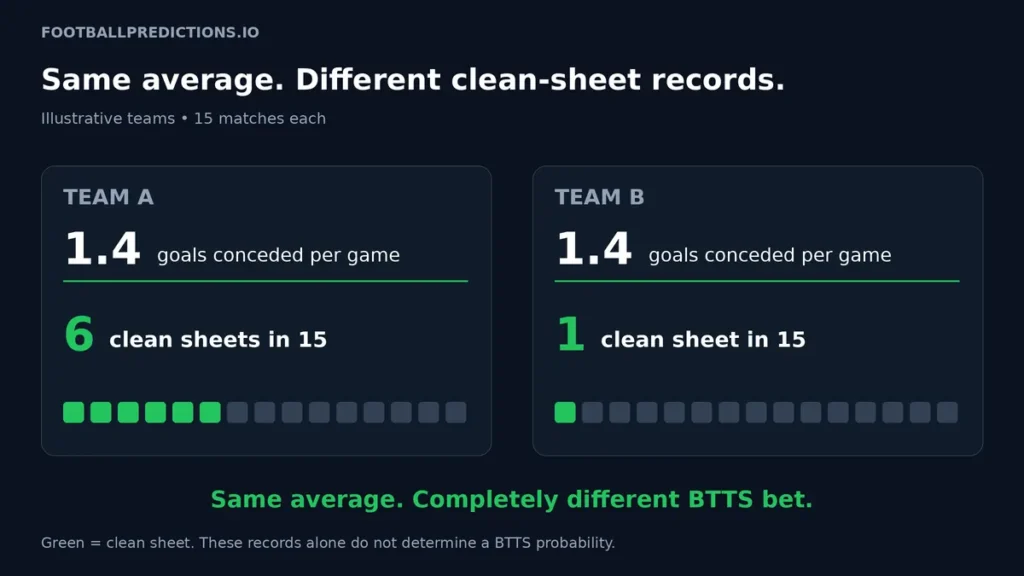
Two teams with identical goal averages can have very different blank-sheet records.
Game state and how a side reacts to going behind
Some teams open up when they concede first — they push bodies forward and the match stretches. Others shut down and settle for damage limitation. The first type is a BTTS Yes asset even when they’re outclassed. The second type kills the bet.
Home and away splits, properly separated
Plenty of mid-table sides are a different team away from home — more conservative, fewer bodies forward, far more likely to be shut out. Season-long averages hide this completely. Split the record and it usually jumps out.
A quick worked example
Say a strong home side hosts a struggling away team. The instinct is BTTS No — the favourite will win comfortably and the visitors won’t threaten.
Now check the details. The home side has kept only two clean sheets in fifteen matches, because they commit numbers forward and leave space behind. The away side has been blanked just four times all season, and three of those were against the division’s top defences. Suddenly BTTS Yes looks a lot more reasonable than the league table suggested.
That gap — between what the table implies and what the underlying records say — is where the value in this market usually sits.
Where people go wrong
- Backing Yes because both teams “attack well.” Attacking quality without defensive vulnerability produces one-sided scorelines, not shared ones.
- Reading a 4-1 as evidence of a high-scoring pattern. It’s one goal from the losing side, and often a consolation at 4-0 with the game already dead.
- Ignoring the favourite’s own clean sheet record. The bet needs the underdog to score, and that’s decided as much by the favourite’s defence as by the underdog’s attack.
- Betting BTTS Yes in cup ties and relegation scraps. Cautious, low-risk matches are where this bet dies quietly.
Judging the price
BTTS Yes typically sits somewhere between 1.60 and 2.10 in the big leagues, which implies roughly a 48-62% chance. Before you take it, ask yourself honestly: do I think the underdog scores more often than roughly half the time in this specific match?
If the answer is “probably, they usually find something” — that’s not good enough. Vague confidence isn’t an edge. You want a concrete reason the market has mispriced it: a clean sheet record that contradicts the reputation, a defensive injury the price hasn’t absorbed, a home side that’s stopped keeping teams out.
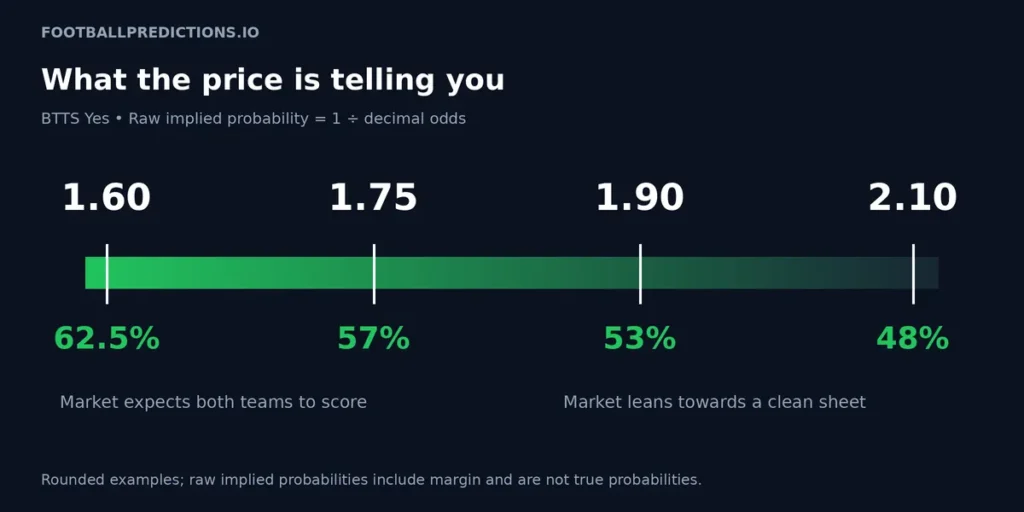
What typical BTTS prices imply about the market’s view of the match.
How BTTS fits into our predictions
Our models produce a full scoreline distribution, which means the BTTS probability comes directly out of the same calculation that generates everything else — we sum the probability of every scoreline where both sides reach at least one. Like every other market on the site, we publish a BTTS tip only when that number and the market price disagree by enough to matter.
Frequently asked questions
Does an own goal count for BTTS?
Yes. It counts for the team that’s credited with the goal on the scoresheet — so an own goal by the away side counts as a home goal for BTTS purposes.
Is BTTS easier to win than a match result bet?
Not really. It removes the need to pick a winner but adds a different requirement — both sides scoring — that fails in plenty of matches a result bet would have won.
What’s the best league for BTTS betting?
There’s no single answer, but leagues with less defensive organisation throughout the table tend to produce more shared scorelines. What matters far more than the league is the specific matchup and whether the price reflects it.
Can I combine BTTS with over 2.5?
Yes, most bookmakers offer it as a combined market at a longer price. Just remember you now need both conditions — three or more goals and at least one from each side — so it’s a meaningfully harder bet than either one alone.
How many matches should I check before betting BTTS?
Ten or more per team, split into home and away. And count clean sheets and blanks rather than goals — those are the numbers this market runs on.
Why did BTTS lose when the match finished 4-0?
Because BTTS needs both teams to score, not a certain number of goals. A 4-0 has plenty of goals but only one scoring team, so BTTS Yes loses while over 2.5 wins comfortably.
The short version: stop asking whether a match will have goals, and start asking whether the weaker side will get one. Everything useful in this market follows from that question.
18+. Betting involves risk and you should never stake more than you can afford to lose. If gambling stops being fun, support is available at GambleAware.org.