Is double chance betting safe? Not in the way most people think: it wins more often, but at a price that leaves you almost no room to be wrong.
Double chance has a reputation it hasn’t earned. Ask most bettors and they’ll tell you it’s the sensible option — the one you take when you want to be careful. Two outcomes covered instead of one, wins far more often than it loses, nothing reckless about it.
I want to argue the opposite. Not that it’s a bad bet, but that “safe” is exactly the wrong word for it, and believing that word costs people more money than any long shot ever has.
Double chance explained: 1X, X2 and 12
Three possible results in a football match. Double chance lets you back two of them.
| Option | Written as | Loses only if |
|---|---|---|
| Home or draw | 1X | Away wins |
| Away or draw | X2 | Home wins |
| Home or away | 12 | It’s a draw |
That’s the whole market. Now the part nobody thinks about.
Is double chance betting safe? The word “safe” does the damage
A typical match: home 2.20, draw 3.40, away 3.30. Convert those odds into implied probability and the market rates the home side at about 45%, the draw at 29%, the away side at 30%.
Home or draw covers roughly 74% of that. Fair price, about 1.35. Your bookmaker will offer around 1.30.
So you’ve swapped a bet that wins 45% of the time for one that wins three quarters of the time. That feels like an obvious improvement. It isn’t an improvement at all — it’s the same bet wearing different clothes, and the bookmaker has taken his cut either way.
If anything, the cut is bigger. Pricing a 74% chance at 1.30 instead of 1.35 is a wider bookmaker’s margin than the one on the straight home win.
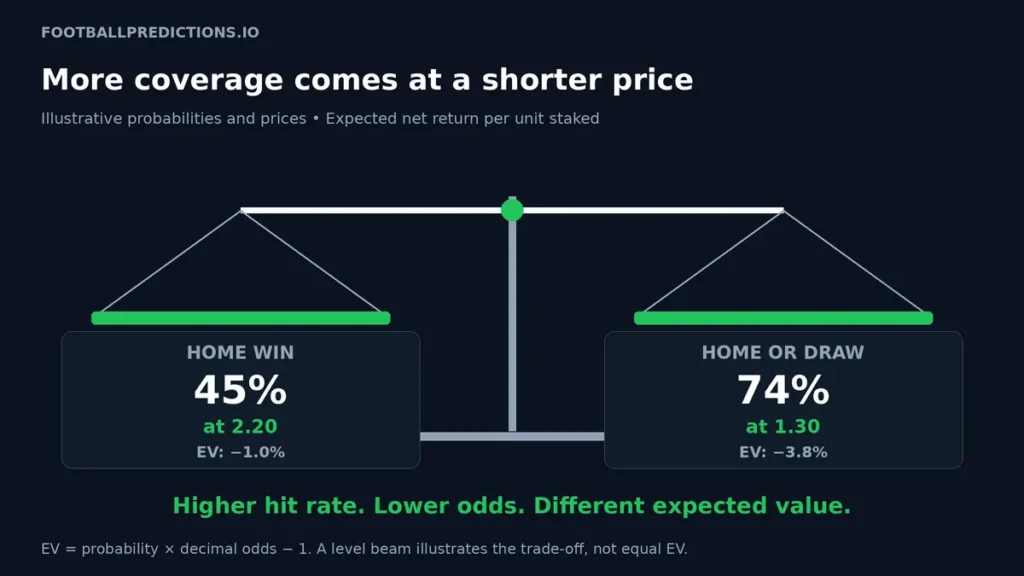
More coverage, a shorter price — and a worse expected value than the straight home win.
Double chance break-even odds: at 1.30 you have almost no room to be wrong
Here’s the number that should stop you: at odds of 1.30, you need to win 77% of your bets to break even. Not to make money. To come out level.
Think about what 77% actually demands. Roughly three losses in every thirteen bets, and no more.
Miss by five percentage points — win 72% instead, which still looks excellent on a betting history — and you’re bleeding money every month. Not a single result along the way felt like a disaster.
| Odds | You must win | Losses you can afford per 20 bets |
|---|---|---|
| 1.20 | 83.3% | 3 |
| 1.30 | 76.9% | 4 |
| 1.45 | 69.0% | 6 |
| 1.60 | 62.5% | 7 |
Compare that to a 2.50 bet, where you can lose three out of five and still break even. Which one is really the risky position?
Frequent wins hide what’s happening
This is the psychological trap, and it’s the reason I think double chance deserves more suspicion than it gets.
Losing slowly at short odds doesn’t feel like losing. You collect on Saturday, you collect on Sunday, and the account ticks along. Somewhere over three months it’s quietly smaller than when you started.
Nobody reviews a staking plan after a winning weekend. That’s the problem — the feedback never arrives.
A bettor who backs 2.50 shots loses regularly and notices. A bettor who backs 1.30 double chances loses rarely and doesn’t. Guess which one is more likely to still be in the game next year.
When to bet double chance: three narrow cases
Three situations, and they’re narrower than most people assume.
When you specifically rate the draw
Two organised, evenly matched sides in a fixture where neither needs to chase. If your read is that the draw is genuinely underpriced, 1X or X2 pays you for that view while keeping a win in play.
This is the only case where double chance is doing something a normal bet can’t.
When an away underdog is being dismissed too easily
Markets price the away win long and then forget that a compact, well-drilled visitor draws plenty of matches. X2 sometimes carries a price that hasn’t caught up with that.
When the book has priced it lazily
Occasionally a double chance price doesn’t quite line up with the 1X2 market it was derived from. Rare, worth a glance, not worth hunting for. It’s the same test as any value bet in football: the price has to be wrong, not just the outcome likely.
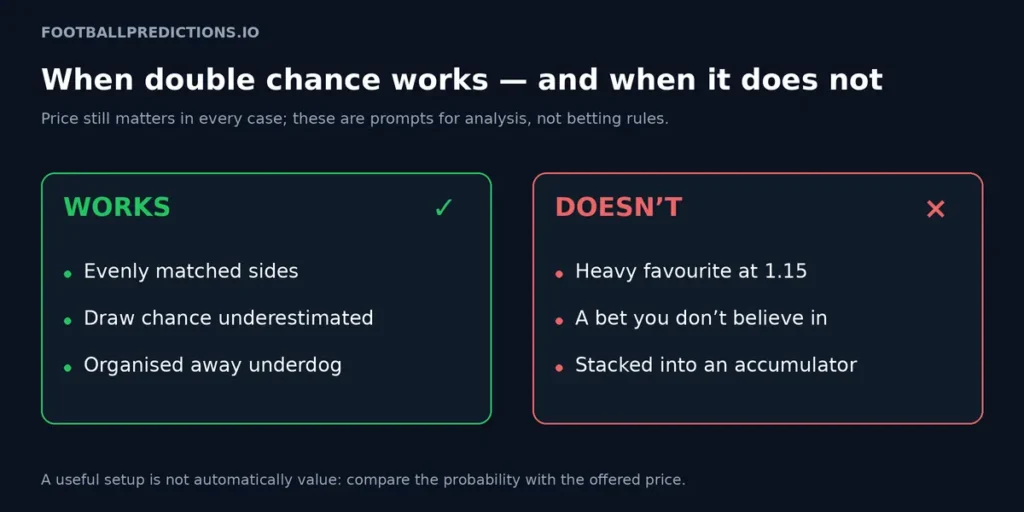
Narrow use cases, and a much longer list of bad ones.
Is double chance a good bet? Not in these cases
The bad uses are more common than the good ones. The last one on this list is the most common of all.
- On a heavy favourite. On a favourite already priced at 1.40, double chance gives you something near 1.15. You’re risking seven units to win one, and a single upset erases six wins. There’s no version of that trade that makes sense.
- Stacked into accumulators. It’s worse — four short legs, four slices of margin, and a return you could have got from one decent single.
- Because you’re unsure about a match. Covering more outcomes doesn’t manufacture an opinion. It’s the same trap as betting both teams to score just to avoid picking a winner. If you don’t have a read, the answer is to skip the game, not to buy a softer version of a bet you didn’t want to make.
Double chance vs draw no bet: usually the better tool
Worth knowing the difference, because people use these interchangeably and shouldn’t.
Draw no bet refunds your stake if the match is drawn. Double chance pays out on the draw, at a shorter price to compensate.
- If you rate the draw highly, double chance is correct — you’re being paid for a view you actually hold.
- If you just want protection against a draw you think is unlikely, draw no bet buys that insurance far more efficiently.
One calculation before you click
Divide 1 by the price. That’s your break-even rate. Then say out loud whether you believe the outcome lands more often than that.
At 1.30 you’re claiming the away side wins fewer than one time in four. Maybe you believe that. Most of the time, if you’re honest, you don’t — you just wanted the bet to feel less frightening.
How double chance fits into our predictions
Our models price every result of a match separately, so a double chance probability is simply two of those numbers added together. We treat it like any other market: a tip appears only when our probability and the price disagree by enough to matter. You can read more about how our AI football predictions are built.
Frequently asked questions
What does 1X mean in double chance betting?
1X means home win or draw. You win if the home side wins or the match is drawn, and lose only if the away side wins. X2 is away or draw, and 12 is either team to win.
Does double chance pay out if the match is a draw?
Yes, if you backed 1X or X2 — the draw is one of your two outcomes. The only double chance option that loses on a draw is 12, home or away.
What odds do you need to break even on double chance?
Divide 1 by the odds. At 1.30 you need to win 76.9% of your bets, at 1.20 you need 83.3%, and at 1.45 you need 69%. Fall below that rate and you lose money even while winning most of your bets.
Is draw no bet the same as double chance?
No. Draw no bet refunds your stake if the match is drawn, while double chance counts the draw as a win at a shorter price. Double chance suits you if you rate the draw; draw no bet suits you if you only want protection against it.
So, is double chance betting safe? That’s the whole argument: it isn’t safer betting. It’s the same risk, spread thinner, with less room to be wrong and a comfortable feeling that stops you checking.
Before your next double chance bet, run the one calculation above. Then compare it with the probabilities behind today’s free football predictions.
18+. Betting involves risk and you should never stake more than you can afford to lose. If gambling stops being fun, support is available at GambleAware.org.