“Value” is the most overused word in betting and the least understood. Most people hear it and think it means a good price — a big number, long odds, a nice potential payout. That’s not what it means at all, and mixing the two up is one of the fastest ways to lose money steadily without noticing.
This guide explains what value betting actually is, how to calculate it with a simple formula, where the estimate of “true probability” comes from, and why finding value is a completely different skill from picking winners. Get this right and it becomes the single idea everything else in betting strategy sits on top of.
What value betting actually means
A value bet is one where the probability you believe an outcome has is higher than the probability the odds imply. It has nothing to do with how likely the bet is to win. A 1.30 favourite can be brilliant value. A 15.00 outsider can be terrible value. The odds alone never tell you — only the gap between the odds and the true chance does.
This is why professional bettors talk so little about “who’s going to win” and so much about “is this price right.” Predicting the outcome and finding value are related but separate jobs, and only the second one makes money over time.
The value formula
Value exists whenever this is true:
(Your estimated probability × decimal odds) > 1
If that number comes out above 1.00, the bet has positive expected value. Below 1.00, it doesn’t — no matter how confident you feel about the pick.
| Your estimated probability | Decimal odds offered | Calculation | Verdict |
|---|---|---|---|
| 55% | 2.10 | 0.55 × 2.10 = 1.155 | Value ✅ |
| 55% | 1.70 | 0.55 × 1.70 = 0.935 | No value ❌ |
| 20% | 6.00 | 0.20 × 6.00 = 1.200 | Value ✅ |
| 70% | 1.35 | 0.70 × 1.35 = 0.945 | No value ❌ |
Notice the fourth row: a 70% favourite, which will win most of the time, is still a bad bet at that price. Losing bettors focus on the 70%. Winning bettors focus on the 0.945.
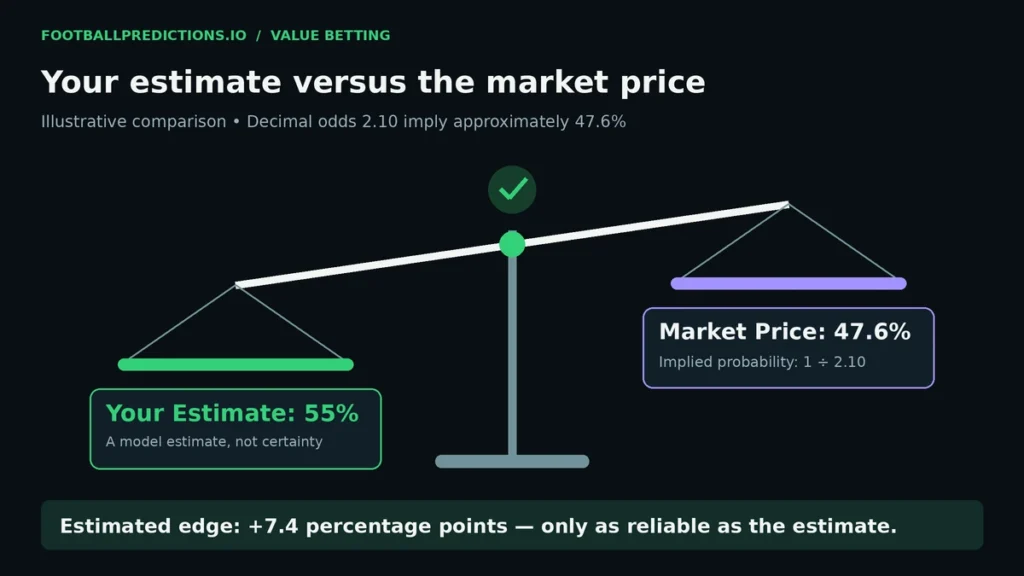
Value lives in the gap between your estimate and the market’s price — not in how likely the outcome feels.
Where “true probability” comes from
This is the hard part, and anyone who tells you it’s simple is skipping something. You can’t know the real probability of a football outcome with certainty — nobody can. What you can do is build a reasonable estimate from the same inputs a good model uses: underlying performance data like xG, recent form, confirmed team news, and situational context such as rest and fixture congestion.
The market itself is also a legitimate input. Odds aggregate the views of thousands of bettors and professional money, which makes the market price a strong starting estimate on its own — before you adjust it with anything you know that the price hasn’t caught up with yet, like a very recent injury.
Why a winning bet isn’t proof of value
This is the part that trips people up the most. A bet can have value and still lose. A bet can have no value and still win. Football has enough randomness — a deflection, a red card, a refereeing decision — that any single result tells you almost nothing about whether the underlying price assessment was correct.
Value is judged by the quality of the decision at the time it was made, not by the outcome afterwards. A poker player who goes all-in with the best hand and loses to a lucky card didn’t make a bad decision — they made a good one that didn’t come off. Betting works exactly the same way.
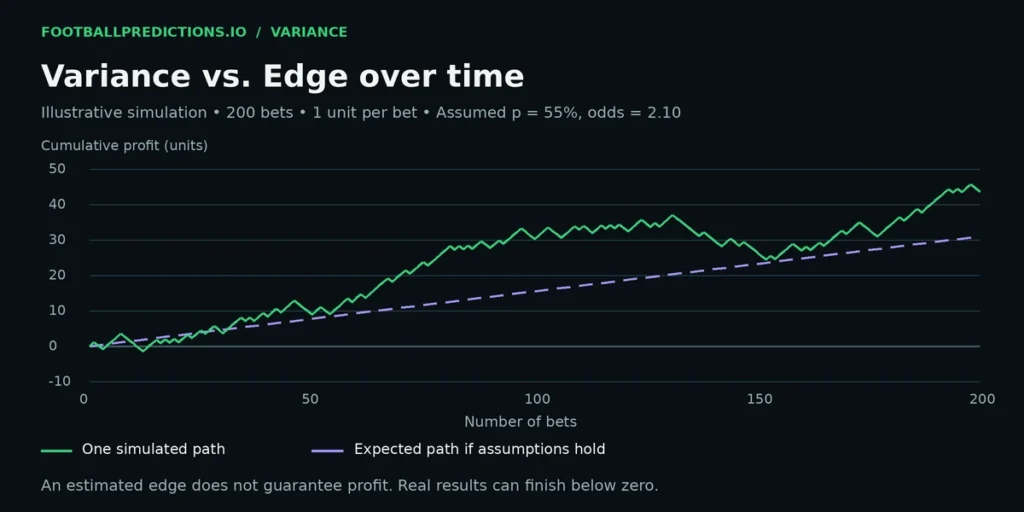
Over enough bets, genuine value shows up as profit — a single result never proves or disproves it.
Why value only shows up over a large sample
Because any one bet is dominated by randomness, value only becomes visible statistically after a large number of similar bets. A 5% edge doesn’t mean winning 5% more often on every bet — it means, over hundreds of bets at similar edges, ending up roughly 5% ahead of what you staked.
This is why serious bettors track closing line value — how their bet’s odds compared to the final market price right before kick-off — as a faster signal than win/loss record. If you consistently beat the closing line, you’re consistently finding value, even during a losing stretch.
A simple three-step process for spotting value
- Estimate a probability first, before looking at the odds. This avoids anchoring your judgment to the price.
- Convert the offered odds to implied probability (1 ÷ decimal odds).
- Compare the two. If your estimate is meaningfully higher — not just marginally, since your estimate has error too — you may have found value.
The word “meaningfully” matters. A 1-2% edge is well within the noise of your own estimation error. Look for gaps wide enough to survive being slightly wrong about your own numbers.
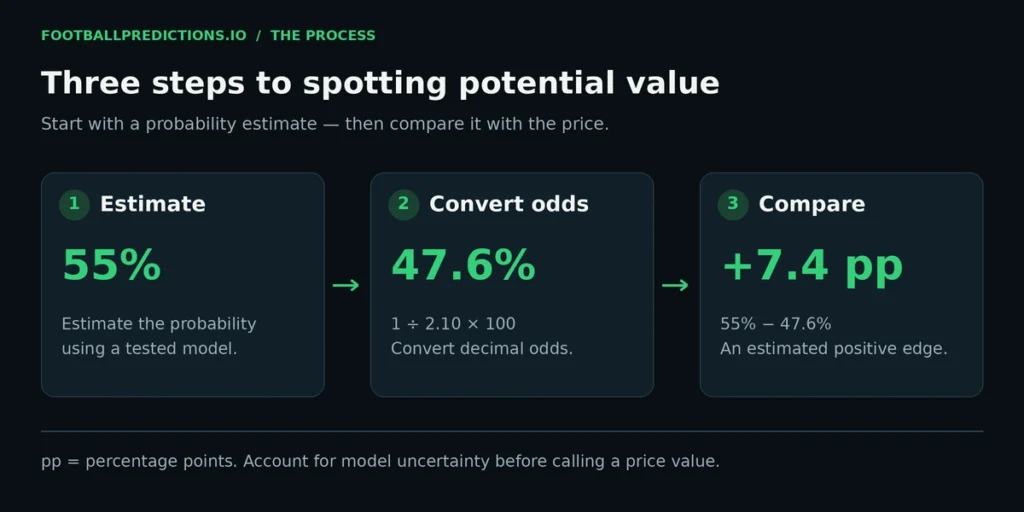
The three-step process, applied to a real selection.
How we apply this on FootballPredictions.io
Every tip we publish goes through exactly this comparison: our model’s probability against the market’s implied probability, and only matches with a meaningful gap between the two make it onto the site. That’s also why we don’t publish a prediction on every match — most matches are priced close enough to fair that there’s no real edge to report.
Frequently asked questions
What is a value bet in simple terms?
A bet where you believe the true chance of the outcome is higher than what the odds suggest. It’s about the price being wrong in your favour, not about how likely the bet is to actually win.
Can a favourite be a value bet?
Yes. If a team’s true win probability is 75% but the odds only imply 68%, that favourite carries value — even though it was already the most likely outcome before you looked at the price.
How do I know my probability estimate is any good?
Track it over time. If the outcomes you rate as 60% chances actually happen roughly 60% of the time across a large sample, your estimates are well-calibrated. Consistent gaps in one direction mean your process needs adjusting.
Does value betting guarantee profit?
No. It shifts the odds in your favour over a large number of bets, but any individual bet can still lose. Variance is real, and a genuine edge can still produce a losing month or even a losing season in a small sample.
Why did my value bet lose?
Because value describes an edge in probability, not a certainty. A 60% chance still fails 40% of the time. One result, in either direction, doesn’t confirm or disprove whether the original assessment was sound.
What’s the difference between value betting and just picking winners?
Picking winners asks “who will win?” Value betting asks “is this price wrong?” You can correctly pick the winner and still make a bad bet if the price didn’t compensate you for the risk, and you can correctly find value and still lose the individual bet.
Value betting isn’t a trick or a shortcut — it’s a discipline. It means judging every price on its own terms, resisting the pull of “safe-feeling” favourites and “exciting” long shots alike, and trusting the process over any single result. That discipline, kept up over hundreds of bets, is the difference between gambling and betting with an edge.
18+. Betting involves risk and you should never stake more than you can afford to lose. If gambling stops being fun, support is available at BeGambleAware.org.