Open any match on a betting site and you’ll see numbers like 1.85, 5/4, or +150 sitting next to the same team. They all mean exactly the same thing, expressed in three different systems — and if you can’t convert between them in your head, you’re comparing prices blind.
This guide explains what betting odds actually represent, how to read all three formats, how to turn any odd into a probability, and why the number you see is never quite a fair one. By the end you’ll be able to look at any price and know immediately whether it’s worth taking.
What betting odds actually represent
An odd is a price. It tells you two things at once: how much you’d win if a bet comes in, and — hidden inside that number — how likely the bookmaker thinks the outcome is. The higher the odd, the less likely the event is considered, and the more you’re paid if you’re right.
Bookmakers don’t set odds to predict the future accurately. They set them to balance their books and guarantee a margin regardless of the result. Understanding that changes how you should read every price on the page.
The three odds formats
Decimal odds (1.85, 2.50, 4.00)
The standard format across Europe, Australia and most modern betting sites. The number is your total payout per unit staked, stake included. Bet €10 at 2.50 and a win returns €25 — €15 profit plus your original €10 back. This is the easiest format for quick mental maths, which is why it’s used throughout this site.
Fractional odds (5/4, 6/1, 1/2)
Traditional in the UK and Ireland. The fraction shows profit relative to stake: 5/4 means you win £5 for every £4 staked. A number above the fraction bigger than the one below (6/1) means a bigger profit than your stake; the reverse (1/2) means a smaller one — a “short” price on a strong favourite.
American / moneyline odds (+150, -200)
Standard in the US. A plus sign shows profit on a 100-unit stake (+150 = bet 100, win 150 profit). A minus sign shows how much you must stake to profit 100 (-200 = bet 200 to win 100 profit). Plus-money odds are underdogs; minus-money odds are favourites.
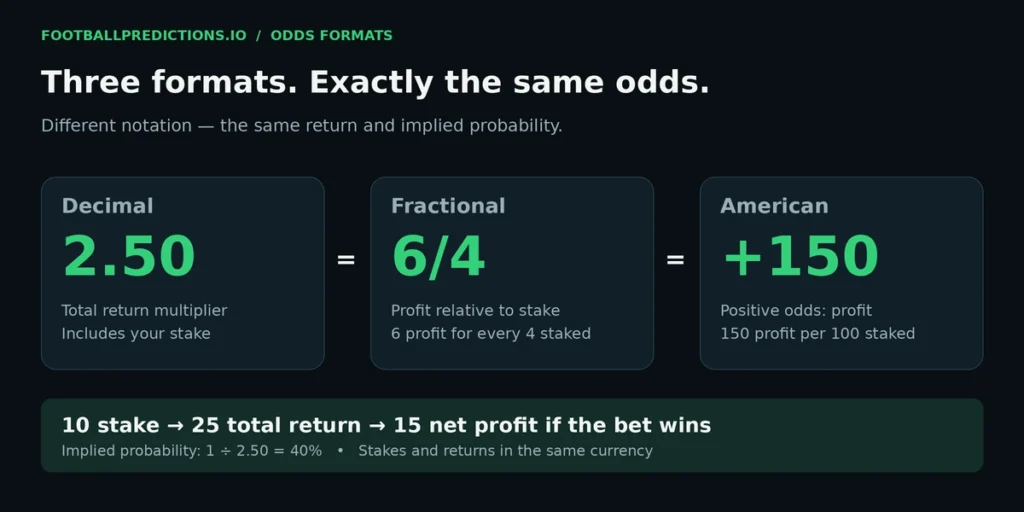
The same price, shown in all three formats side by side.
Converting between formats
You don’t need to memorise every conversion — just the formulas that get you to decimal, since everything else follows from there.
| From | To decimal |
|---|---|
| Fractional (a/b) | (a ÷ b) + 1 |
| American, positive (+X) | (X ÷ 100) + 1 |
| American, negative (-X) | (100 ÷ X) + 1 |
Example: 5/4 → (5 ÷ 4) + 1 = 2.25. And +150 → (150 ÷ 100) + 1 = 2.50. Once everything is in decimal, comparing prices across different sites and formats becomes trivial.
Implied probability: what the odd is really telling you
Every decimal odd hides a probability. The formula is one line:
Implied probability = 1 ÷ decimal odds
| Decimal odds | Implied probability |
|---|---|
| 1.33 | 75.2% |
| 1.85 | 54.1% |
| 2.50 | 40.0% |
| 4.00 | 25.0% |
| 10.00 | 10.0% |
This is the single most useful skill in reading odds. Once you can convert a price to a probability instantly, you can compare it against your own judgment — or against a model’s — and see immediately whether there’s a gap worth acting on.
The overround: why the probabilities never add up to 100%
Add up the implied probabilities of every outcome in a match — home, draw, away — and the total is never exactly 100%. It’s usually somewhere between 105% and 108%. That extra few percent is called the overround, or the bookmaker’s margin, and it’s built into every single price.
It’s how bookmakers make money regardless of who wins. A market with a 106% overround means that, priced fairly, the bookmaker keeps roughly 5.7% of all money staked over the long run — before considering which side the public actually bets on.
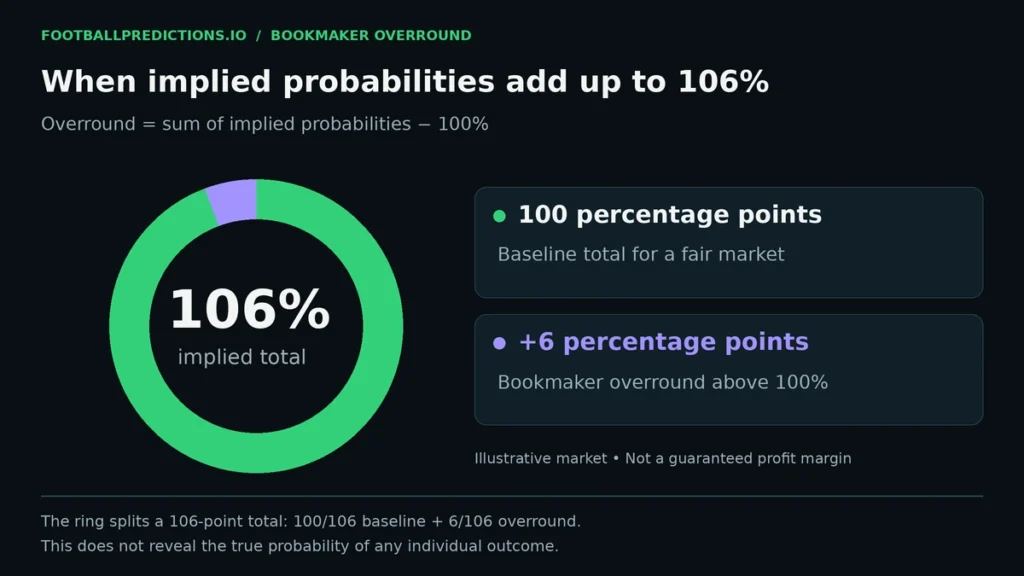
A 106% market: the shaded slice is the bookmaker’s built-in margin.
This is why “the fair odds” and “the odds you’re offered” are never quite the same number, and why beating the market consistently means beating it by more than the margin, not just picking more winners than losers.
Why odds move before kick-off
Odds aren’t fixed the moment a match is scheduled. Three things move them:
- Money. Heavy betting on one side pushes its price down and the other side’s up, keeping the book balanced.
- News. A confirmed injury, a lineup leak, or a managerial change moves prices within minutes.
- Sharp money. Bookmakers watch which professional bettors are moving on a price, and adjust to protect themselves even before the public reacts.
A price two days before kick-off and the same price twenty minutes before it can reflect very different information. Late movement is usually more informed than early movement.
Comparing odds across bookmakers
Because every bookmaker sets its own margin and reacts to money slightly differently, the same match can carry noticeably different prices in different places. Shopping the best available price on your selection — rather than always using the same site — is one of the few completely free edges in betting: it costs nothing and compounds over hundreds of bets.
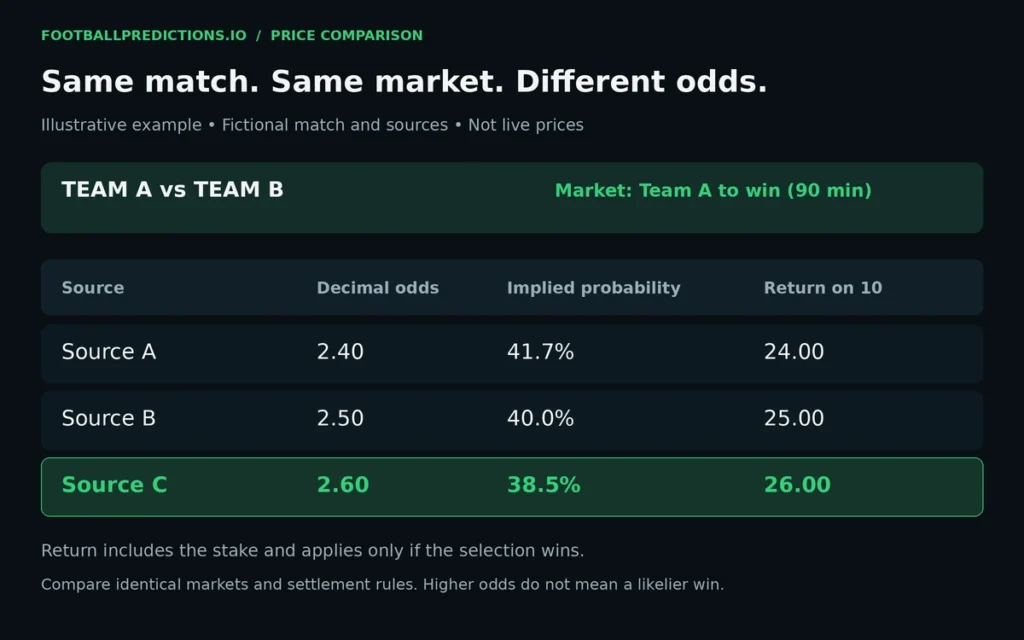
The same selection can carry a meaningfully different price depending on where you look.
Common mistakes beginners make with odds
- Confusing a short price with a safe bet. 1.20 still loses roughly one time in six. “Likely” is not “certain.”
- Ignoring the overround when judging value. A bet that looks 50/50 to you at even money (2.00) isn’t automatically good value once the bookmaker’s margin is priced in.
- Never shopping for a better price. Taking whatever number the first site shows, on every single bet, quietly costs money over a season.
- Reading odds as a prediction rather than a price. A 1.50 favourite isn’t “expected to win comfortably” — it’s priced at roughly a 67% chance, which still means a loss one time in three.
How this connects to our predictions
Every tip on this site is published alongside the odds it was judged against, so you can see exactly what implied probability the market was offering versus what our model estimated. Understanding the mechanics in this guide is what makes that comparison meaningful rather than just another number on the page.
Frequently asked questions
Which odds format should I use as a beginner?
Decimal. It’s the simplest to calculate payouts from directly, works the same way for favourites and underdogs, and is the default on nearly every major site outside the UK and US.
What does a decimal odd of 1.00 mean?
It would mean a 100% implied probability and zero profit — in practice you’ll never see it, since a real market never prices anything as fully certain.
Why do bookmakers’ odds differ from the “true” probability?
Because every price includes the overround, the bookmaker’s built-in margin. The true, fair probability is always somewhat higher than what the odd implies.
Is it worth using multiple bookmakers?
Yes. Comparing prices before betting, known as odds shopping, is free and consistently improves long-term results by capturing the best available price on each selection.
Do higher odds always mean higher risk?
Generally yes — a higher odd reflects a lower implied probability. But “risk” and “value” are different things: a high price can still be good value if the real chance is even higher than the market thinks.
Why do odds sometimes change right before kick-off?
Late team news, lineup confirmations and a final wave of betting activity all move prices in the last hour before a match, which is often when odds are most accurate.
Odds are a price, not a prophecy. Reading them fluently doesn’t tell you who’s going to win — it tells you exactly what you’re being offered, so you can decide for yourself whether it’s a fair deal.
18+. Betting involves risk and you should never stake more than you can afford to lose. If gambling stops being fun, support is available at BeGambleAware.org.