Every day, thousands of people search for AI football predictions — and almost none of those sites explain what actually happens between the data and the tip on your screen. That gap matters. A prediction you don’t understand is just someone else’s opinion with a percentage sign attached to it.
This guide opens the box. You’ll see which data goes into a football prediction model, how that data becomes a probability, why the bookmaker’s odds are part of the calculation rather than the enemy of it, and — just as importantly — what no model can tell you. By the end you’ll be able to look at any prediction, including ours, and judge whether it’s worth anything.
What is an AI football prediction?
An AI football prediction is a forecast produced by a statistical or machine-learning model that has been trained on historical match data. Instead of guessing a winner, the model estimates the probability of each outcome — home win, draw, away win, goals, cards — and converts the strongest edge into a tip.
The important word is probability. A human tipster says “Arsenal will win.” A model says “Arsenal win 61%, draw 23%, away win 16%.” Those are very different claims. The second one is falsifiable, measurable and improvable over thousands of matches. The first one is a feeling.
The data behind every prediction
A model is only as good as what you feed it. Ours — and any serious system — draws on five layers of data.
1. Match results and historical fixtures
The foundation is years of results across each competition: goals scored, goals conceded, home and away splits, and margins of victory. This is where a team’s baseline attacking and defensive strength comes from. A minimum of one to two full seasons per league is needed before the numbers stop being noise.
2. Shot quality and expected goals (xG)
Raw results lie more often than people think. A team can win 1-0 having created almost nothing, or lose 0-1 after 25 shots. Expected goals measures the quality of chances created rather than whether they happened to go in, which makes it far more stable from match to match than the scoreline. A side whose xG consistently outruns its actual goals is usually about to improve — and the model sees that before the league table does.
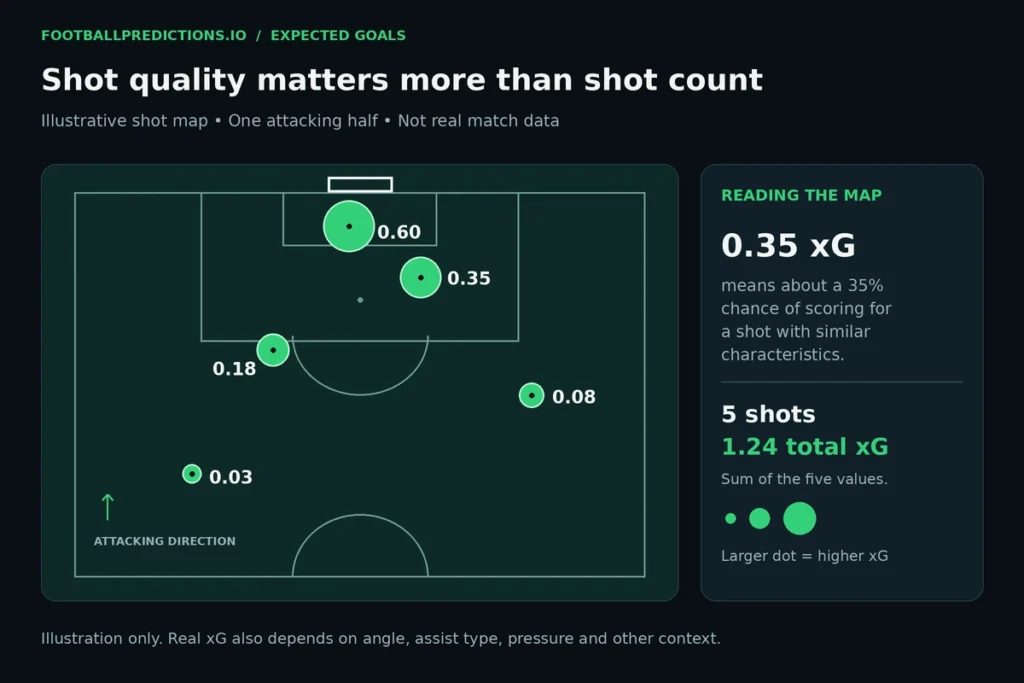
Not every shot is worth the same. xG scores each chance by how often shots like it are scored.
3. Team news, lineups and squad rotation
A missing first-choice striker or centre-back can move a team’s win probability by several percentage points. Confirmed lineups arrive about an hour before kick-off, which is why late-updating predictions are more accurate than ones published three days early — and why a model needs to flag when it’s working with incomplete information.
4. Context: rest, travel, congestion and motivation
Days since the last match, European midweek fixtures, distance travelled, altitude, and whether a team has anything left to play for in May all shift the numbers. These effects are small individually but they compound across a season, and they’re the most common reason a “strong” favourite underperforms.
5. The betting market itself
This surprises people: good models read the odds. The betting market aggregates the opinions of millions of participants and a fair amount of professional money, which makes it one of the sharpest single predictors available. A model that ignores the market entirely is throwing away information. A model that only copies the market adds nothing. The useful zone is in between.
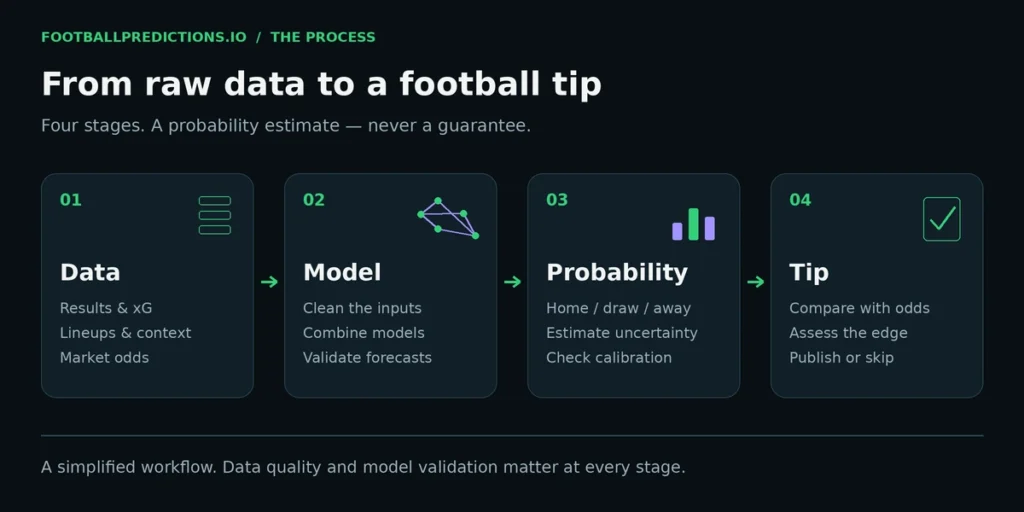
The four stages every published tip goes through.
From data to probability: how the model actually works
There isn’t one algorithm behind football predictions. There are families of them, usually combined.
Poisson and goal-based models
The classic approach treats goals as a Poisson process: estimate each team’s attacking strength and the opponent’s defensive weakness, produce an expected goal count for both sides, then calculate the probability of every possible scoreline from 0-0 upwards. Sum the relevant cells and you have your 1X2, over/under and both-teams-to-score probabilities in one pass.
Its known weakness is that it slightly underestimates draws and low-scoring games, because real football goals aren’t perfectly independent events. Adjustments such as the Dixon-Coles correction exist specifically to fix this.
Team rating systems
Elo-style ratings give every team a single number that rises and falls after each result depending on the strength of the opponent and the margin. They’re simple, robust, and excellent at tracking form over time — which makes them a useful sanity check on more complex models.
Machine learning models
Gradient-boosted trees and neural networks can absorb dozens of features at once — xG, rest days, home splits, market odds, weather — and learn interactions a human would never hand-code. The trade-off is that they need a lot of data and they’re prone to overfitting: learning the quirks of the training set rather than the underlying game. The defence is strict validation on matches the model has never seen.
Ensembles
In practice the best results come from combining approaches and weighting them by how each has performed recently. When a Poisson model, a ratings model and a machine-learning model all point the same way, confidence is high. When they disagree, that disagreement is itself information — and usually a reason to skip the match.
Probability vs odds: where value comes from
Once you have a probability, the tip isn’t automatic. You compare the model’s number to what the market is offering. Every odd implies a probability, and the formula is simple:
Implied probability = 1 ÷ decimal odds
| Decimal odds | Implied probability | Model probability | Edge |
|---|---|---|---|
| 1.50 | 66.7% | 64% | −2.7% — no bet |
| 1.80 | 55.6% | 62% | +6.4% — value |
| 2.50 | 40.0% | 41% | +1.0% — too thin |
| 4.00 | 25.0% | 19% | −6.0% — no bet |
Only the second row is worth backing. The model thinks the outcome is more likely than the price suggests, and by a margin wide enough to survive the bookmaker’s built-in commission. The third row is technically positive but too thin to trust — model error alone could account for it.
This is why a good prediction site doesn’t publish a tip on every match. Most matches are priced correctly. Finding the ones that aren’t is the entire job.
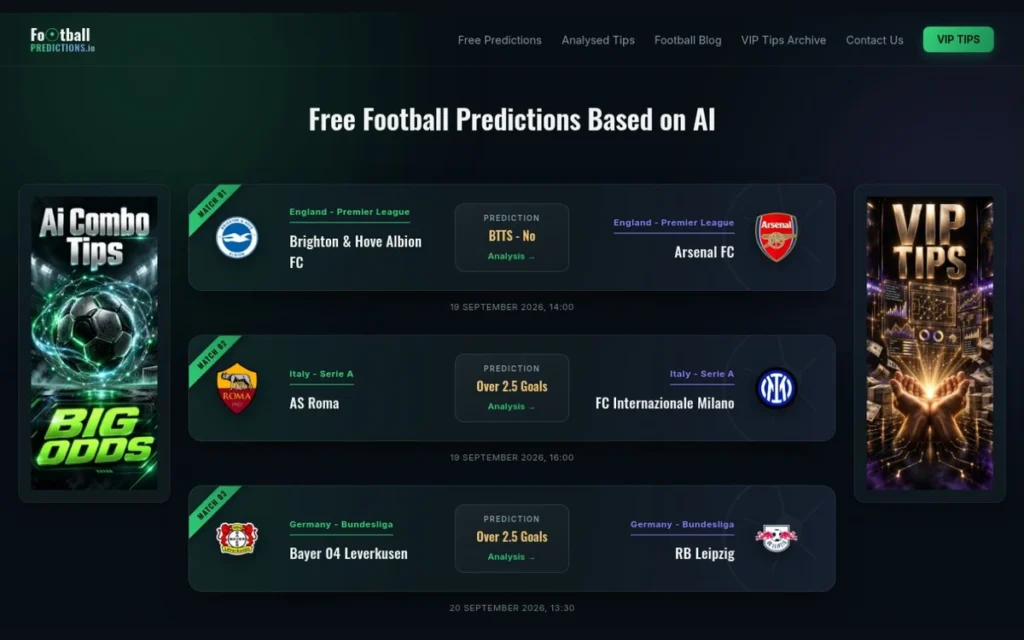
Every published tip carries the market, the selection and a link to the full analysis.
What AI cannot predict
Anyone promising certainty is selling something. Here’s what stays outside the model:
- Red cards and early injuries. A sending-off in the 12th minute rewrites the match. No model sees it coming.
- Deflections, woodwork and goalkeeping errors. Football is low-scoring, which means single random events decide a huge share of results. A 55% favourite loses roughly four times in nine.
- Dressing-room situations. Contract disputes, a manager about to be sacked, a squad unhappy about conditions — these rarely appear in structured data.
- Genuinely new situations. Newly promoted clubs, a squad rebuilt with twelve signings, or a first competitive meeting between two sides give the model very little to work with.
- Small leagues with thin data. Lower divisions and minor competitions have fewer recorded matches and less reliable statistics, so confidence intervals widen sharply.
A model that admits this is more trustworthy than one that doesn’t.
How to judge an AI tipster: a five-point checklist
Use this on any prediction site, including this one.
- Does it publish its record, including losses? Anyone can screenshot winners. A full, dated, unedited history is the only meaningful evidence.
- Is the sample big enough? Fewer than 200-300 settled tips tells you almost nothing. Luck dominates below that.
- Does it report ROI, not just hit rate? A 70% strike rate at odds of 1.20 loses money. A 45% strike rate at 2.60 is excellent. Profit per unit staked is the only number that matters.
- Does it give probabilities, not just picks? A site that says “62% confidence” can be scored for calibration. A site that shouts “BANKER” cannot.
- Does it explain the reasoning? If the site can’t tell you why, it probably doesn’t know why either.
How we generate predictions at FootballPredictions.io
Our system runs daily across the fixtures we cover. It pulls match data, form, xG and team news, runs an ensemble of the models described above, and produces a probability for each main market. Those probabilities are then compared against current market prices, and only matches where the gap is wide enough to be meaningful are published as tips.
We focus on lower-odds, higher-probability selections, because that’s where our models are best calibrated and where the variance is survivable for a normal bankroll. Every tip comes with the reasoning attached — you can read the full write-up for any match in our analysed tips section, and see how previous selections landed in the tips archive.
Using predictions sensibly
Even the best model is a long-term instrument. Three rules make the difference between using predictions well and using them badly:
- Stake the same amount every time. Flat staking removes the single biggest cause of blown bankrolls: chasing losses.
- Judge results over months, not days. Ten tips is a coin flip. Three hundred is a signal.
- Never stake money you need. Betting is entertainment with a cost, not an income strategy. If it stops feeling that way, stop.
Frequently asked questions
Are AI football predictions accurate?
A well-built model is typically right on the most likely outcome in around 50-55% of matches, which sounds modest but is meaningful — the point isn’t to be right most of the time, it’s to be right more often than the odds imply. Any site claiming 90%+ accuracy is either counting only its wins or not counting at all.
Can AI beat the bookmakers?
Sometimes, on specific markets, by small margins that require discipline and volume to realise. Bookmakers employ their own modelling teams and adjust prices constantly, so any edge is narrow and temporary rather than a guaranteed income.
Which data matters most in football prediction?
Expected goals and recent underlying performance carry more weight than raw results, with confirmed team news the biggest single late adjustment. Head-to-head history matters far less than most people assume, especially when squads have changed.
Why do predictions change before kick-off?
Because the inputs change. Confirmed lineups, late injury news and market movement all arrive in the final hours, and a model that ignores them is working with old information.
Are your predictions free?
Yes. Daily predictions on the site are free to read, with no registration required. We also offer a separate paid pick for people who want a single focused selection each day.
Do I need to understand statistics to use them?
No. The probability and the reasoning are written in plain language on every tip. Understanding the method just helps you know when to trust it more — and when to skip.
AI football predictions aren’t magic and they aren’t a scam — they’re a way of processing more information, more consistently, than any person can manage by hand. Used with realistic expectations and a flat staking plan, they’re a genuinely useful tool. Used as a guarantee, they’ll disappoint you like every other guarantee in this industry.
18+. Betting involves risk and you should never stake more than you can afford to lose. If gambling stops being fun, support is available at BeGambleAware.org.